Showing posts with label Articles. Show all posts

Sunday, 17 February 2013

Job Burnout

What is Job Burnout ? 


Burnout is a state of emotional and physical exhaustion caused by excessive and  prolonged stress. It can occur when you feel overwhelmed and unable to meet constant demands. As the stress continues, you begin to lose the interest or motivation that led you to take on a certain role in the first place. Burnout reduces your productivity and saps your energy, leaving you feeling increasingly hopeless, powerless, cynical, and resentful. The unhappiness burnout causes can eventually threaten your job, your relationships, and your health. 

The Signs of Burnout 


· Frustration and powerlessness 

· Hopelessness 

· Being drained of emotional energy 

· Detachment, withdrawal, isolation 

· Being trapped 

· Having failed at what you’re doing 

· Irritability 

· Sadness 

· Cynicism (people act out of selfishness and nothing can be done about it) 

Causes of Burnout 


1. Lack of recognition or rewards for good work. 

2. Unclear or overly demanding job expectations. 

3. Doing work that’s monotonous or unchallenging. 

4. Working too much, without enough time for relaxing and socializing. 

5. Being expected to be too many things to too many people. 

6. Working in a chaotic or high-pressure environment. 

7. Not getting enough sleep. 

8. Lack of close, supportive relationships. 

9. Pessimistic view of yourself and the world. 

10. Taking on too many responsibilities, without enough help from others. 

Coping with Burnout 


1. Get 30 Minutes of vigorous exercise at least three times a week. 

2. Find moments in the day when you stop, take a breath, and be aware of what is around you. 

3. Learn to sooth yourself and reduce built-up tension. 

4. Get the right amount of healthy sleep. 

5. Organize your activity so that mentally stimulating activity occurs early in the day, soon after you wake up. 

6. Belong to a group of like-minded people. 

7. Take time to appreciate yourself every day. 

8. Surround yourself with friends/family by whom you feel supported.

360 Degree Feedback

 Introduction

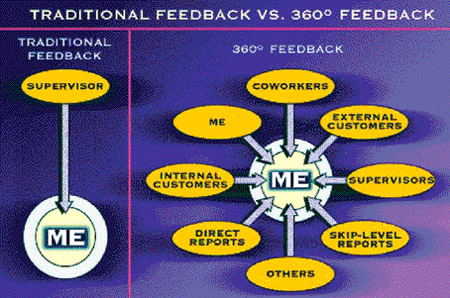
360 degree feedback is a method and a tool that provides each employee the opportunity to receive performance feedback from his or her supervisor and four to eight peers, reporting staff members, coworkers and customers. Most 360 degree feedback tools are also responded to by each individual in a self assessment.


360 Degree Feedback
360 degree feedback allows each individual to understand how his effectiveness as an employee, coworker, or staff member is viewed by others. The most effective 360 degree feedback processes provide feedback that is based on behaviors that other employees can see.

360-degree feedback is also known as multi-rater feedback, multi source feedback, or multi source assessment.

Advantages
  •  Individuals get a broader perspective as to how they   are perceived by others.
  •  The feedback provides a more rounded view of their performance.
  •  Enhanced awareness and relevance of competencies.
  •   Awareness for senior management too, as they will get to know their need for development.
  •   Feedback is perceived more valid and objective as it’s collected from varied sources.

Disadvantages
  •          Frank and honest opinion may not be received.
  •          Stress might be put on individuals for giving   feedback.
  •          Lack of action following feedback.
  •          Over reliance on technology.
  •         Too much bureaucracy (Official Procedure might slow  the process).

Carbon Footprint

What is Carbon Footprint ?

Today, the term “carbon footprint” is often used as shorthand for the amount of carbon (usually in tonnes) being emitted by an activity or organization.


When you use fossil fuels, like heating oil to keep your house warm or gasoline for your family’s car, these things create carbon dioxide, also called CO2. Carbon dioxide is called a greenhouse gas. Many scientists believe that greenhouse gases are making the earth too warm. Your carbon footprint is the total amount of CO2 you create. A big carbon footprint is bad for the planet.

A carbon footprint is composed of two parts, a primary and secondary footprint. The primary footprint is the sum of the direct carbon dioxide emissions of burning of fossil fuels, like domestic energy consumption by furnaces and waters heaters, and transportation, like automobiles and airplane travel. The secondary footprint is the sum of indirect emissions associated with the manufacture and breakdown of all products, services and food an individual or business consumes.

Causes of Carbon Footprint

  •            The world’s population is continuing to grow.
  •   Forests are being cut down.
  •            Fossil fuels are being burned.
  •      Driving and travelling. 
  •         Appliance use. 
  •   Water Use


How to reduce your carbon footprint ? 

1. Replace the light bulbs in your home with long life CFL (compact fluorescent) bulbs. These last up to 15 times longer than regular bulbs and use up 80% less electricity than regular bulbs. You could simply replace your regular bulbs as and when they burn out. 

2. Recycle your waste. 

3. When you next buy a vehicle, go for an electric, hybrid or fuel-efficient car instead of a gas guzzler. 

4. Make compost. 

5. When you mow the lawn, leave the clippings spread across the grass. It decomposes and fertilizes the ground. 

6. Bring your own mug to your favourite coffee shop. This will reduce the usage of the paper cups, the energy used to produce them and save trees. Paper cups are usually not 100% recycled. 

7. Plant a tree this is one of the best things you can do. Trees breathe in carbon dioxide and breathe out oxygen. 

8. Try to use something other than black plastic garbage bags. The black bags can't be recycled because of the black pigment they put in them to make them black. So if possible stick with white or even better dont use any at all. 

9. When replacing household appliances choose energy efficient appliances. You can check their Energy Star ratings for a quick reference. 

10. Use both sides of the page to print or copy. 

11. Unplug your phone charger when not in use. 

12. Use a laptop rather than a desktop. Laptops use up to 80% less energy. 

13. Switch off lights in rooms at home when leaving the room. 

14. Don't wash food under a running tap. 

15. Donate or recycle your old clothing rather than throwing it away.